
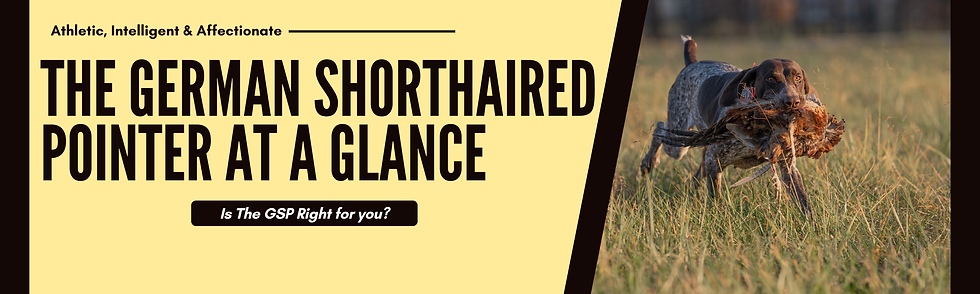
Learn about the German Shorthaired Pointer breed, including temperament, exercise needs, training, socialization, health, and what to expect from life with a GSP. At Nosam Kennels in Central Kentucky, we breed German Shorthaired Pointers for hunting, performance, and active family homes.
German Shorthaired Pointer Breed Information
The German Shorthaired Pointer is an intelligent, athletic, and highly versatile sporting breed known for its strong hunting ability, endurance, and deep connection with its people. At Nosam Kennels, our focus is on producing German Shorthaired Pointers that reflect correct breed type, stable temperament, and proven working ability while also excelling as loyal, active family companions.
A well-bred GSP is confident, biddable, and people-oriented—thriving in homes where they are included in daily life, given structure, and provided both mental and physical purpose.
German Shorthaired Pointer History
The German Shorthaired Pointer has a long history as a versatile hunting dog, developed to perform more than one job in the field. The breed's development centered on creating a dog with a strong nose, natural pointing ability, retrieving instinct, stamina, and the versatility to work across different types of game and terrain.
The modern German Shorthaired Pointer developed in Germany during the 19th century. Breeders worked to combine the qualities of earlier German pointing dogs with other hunting breeds to create a more refined, versatile gun dog. The result was a dog capable of locating and pointing game, retrieving on land and water, tracking wounded game, and working closely with its handler.
Rather than being developed for a single specialized task, the GSP was intended to be an all-purpose hunting companion. This versatility became one of the defining characteristics of the breed and remains an important part of the GSP today.
From German Hunting Dog to Modern GSP
As the breed became more established, breeders continued selecting for the qualities that made these dogs useful hunting partners: a keen nose, natural hunting ability, pointing instinct, retrieving ability, endurance, trainability, and cooperation with the handler.
The German Shorthaired Pointer was eventually introduced to other countries, including the United States, where the breed became increasingly popular among hunters and outdoor enthusiasts. The American Kennel Club recognized the German Shorthaired Pointer in 1930.
Today, the GSP can be found working in fields, forests, and water, participating in hunting and field events, competing in hunt tests and performance sports, and living as an active family companion.
A Breed Built for Versatility
Understanding the history of the German Shorthaired Pointer helps explain why the breed is so energetic, intelligent, athletic, and eager to work. These traits are not accidental—they are part of what the breed was developed to do.
A GSP should be able to use its nose, search for game, point, retrieve, track, and work cooperatively with its handler. At the same time, the breed's affectionate and people-oriented nature has made it a beloved companion outside the hunting field.
At Nosam Kennels, we believe preserving the German Shorthaired Pointer means preserving the whole dog. Structure, temperament, health, and beauty matter, but so do the natural abilities and working qualities that make a GSP a GSP.
The goal isn't simply to produce a dog that looks like a German Shorthaired Pointer. It's to preserve the qualities that have made the breed valuable for generations—and produce dogs that can carry those qualities forward into the field, the performance world, and active family life.
German Shorthaired Pointer Breed Standard & Structure
The German Shorthaired Pointer breed standard describes more than a dog that looks good in the show ring. It describes the structure, balance, movement, and overall type of a versatile hunting dog.
The ideal GSP should give the impression of a medium-sized, athletic, well-balanced dog with the power, endurance, agility, and coordination necessary to work for long periods in the field and water. The AKC standard places particular emphasis on symmetry and field quality, reflecting the breed's original purpose as an all-purpose gun dog.
Balance & Proportion
A well-constructed GSP should appear balanced from every angle, with no single feature overpowering the rest of the dog. The standard describes a dog with a short back while still standing over plenty of ground, giving the breed an athletic outline suited to endurance and efficient movement.
Good structure allows the GSP to cover ground without unnecessary effort. The goal isn't simply to produce a dog with impressive individual features, but one in which all of those features work together.
Head & Expression
The GSP head should be clean-cut and properly proportioned to the body. The expression should convey the breed's characteristic intelligence, energy, and willingness to work.
The eyes are medium-sized and almond-shaped, with a good-humored but alert expression. The ears are set fairly high and should lie close to the head. The muzzle should be sufficiently long and powerful to allow the dog to properly carry game.
Neck, Topline & Body
The neck should transition cleanly into well-laid shoulders and a strong topline. The GSP needs sufficient depth and capacity through the chest while maintaining an athletic, streamlined appearance.
The back should be strong, the loin powerful, and the hindquarters well developed. These characteristics provide the foundation for the drive, stamina, and agility required of a working gun dog.
Forequarters & Hindquarters
The forequarters should provide reach and stability, while the hindquarters provide the driving power necessary for efficient movement.
A properly constructed GSP should be able to move freely and cover significant ground without excessive effort. The structure of the front and rear assemblies should work together rather than creating exaggerated or inefficient movement.
Movement
Movement is one of the clearest ways to evaluate whether a GSP's structure is working as it should.
The breed standard calls for a smooth, coordinated gait with good reach in front and powerful drive from behind. As speed increases, the legs naturally converge toward a more efficient path beneath the body. The goal is maximum ground coverage with minimum wasted motion.
For a breed developed to hunt for hours over varied terrain, efficient movement isn't simply beautiful—it is functional.
Coat & Color
The German Shorthaired Pointer has a short, taut coat suited to its working purpose. The AKC standard recognizes solid liver and several liver-and-white patterns, as well as solid black and several black-and-white patterns. The current standard was revised effective January 1, 2023, including the removal of black as a disqualification.
Color should never overshadow the overall quality of the dog. Structure, temperament, health, and working ability are all important parts of evaluating a breeding prospect.
What the Standard Means to Us
At Nosam Kennels, we don't view the breed standard as a checklist of individual parts. We look at the complete dog.
A beautiful head cannot compensate for poor structure. A flashy outline means little if a dog cannot move efficiently. And excellent conformation alone does not make a complete German Shorthaired Pointer.
We strive for dogs that combine correct structure, sound movement, quality temperament, health, and natural working ability—the characteristics that allow a GSP to function as the versatile hunting dog it was bred to be.
For us, the ideal German Shorthaired Pointer is one that can hunt hard, move correctly, perform confidently, and come home ready to be part of the family.
German Shorthaired Pointer Hunting & Working Ability
The German Shorthaired Pointer was developed to be a versatile, all-purpose hunting dog—a dog capable of finding game, pointing, retrieving, and working alongside its handler in a variety of terrain and conditions. That versatility remains one of the defining characteristics of the breed today.
Pointing
A GSP's natural pointing instinct is one of the defining traits of the breed. Using their exceptional nose and ability to work the wind, GSPs search for upland birds and indicate the location of game by freezing on point. A well-developed pointing instinct, combined with cooperation and trainability, allows the dog and handler to work together as a team in the field.
Retrieving
The GSP was not developed solely to locate and point birds. They are also expected to retrieve game, both on land and in water. A natural desire to retrieve, a soft mouth, persistence, and willingness to return to the handler are valuable qualities in a working GSP.
Tracking
Versatility extends beyond pointing birds. German Shorthaired Pointers have the nose, determination, and athleticism to follow scent and track wounded game. Tracking ability is another example of why the GSP was developed as an all-purpose hunting companion rather than a dog specialized for only one task.
Upland Hunting
The GSP truly shines as an upland bird dog. Their stamina, athleticism, nose, search pattern, and desire to work allow them to cover ground while remaining connected to their handler. Whether hunting pheasant, quail, grouse, or other upland birds, a good GSP should have the desire and ability to hunt with purpose while maintaining cooperation with the person beside them.
Water Work
A versatile GSP should be comfortable working in water as well as on land. Retrieving waterfowl requires confidence, persistence, and the willingness to enter the water and complete the retrieve. Water work is an important part of the breed's versatility and is incorporated into programs such as NAVHDA's testing system.
Versatility
What makes the German Shorthaired Pointer special is not simply that they can point, retrieve, or track individually—it is their ability to bring those skills together in one working dog.
NAVHDA defines a versatile hunting dog as one bred and trained to dependably hunt and point game, retrieve on both land and water, and track wounded game on both land and water.
That versatility is also reflected in the many activities GSPs can participate in beyond hunting, including field events, hunt tests, tracking, scent work, obedience, agility, dock diving, and other performance sports.
Hunt Tests & NAVHDA
Hunt tests and versatile-dog testing provide structured ways to evaluate the abilities that make a GSP a useful working partner. AKC pointing breed hunt tests evaluate dogs at different levels of training and accomplishment, while NAVHDA evaluates qualities such as nose, search, pointing, tracking, retrieving, water work, cooperation, desire, stamina, and obedience.
These programs are not simply about collecting titles. They provide opportunities to demonstrate and evaluate the natural abilities, trainability, and working partnership that are important to the breed.
Why Working Ability Matters in Responsible Breeding
At Nosam Kennels, we believe a German Shorthaired Pointer should be more than beautiful. They should be capable of doing the work the breed was created to do.
Working ability gives us valuable information about what is behind a pedigree. Natural hunting instinct, pointing ability, desire to retrieve, trainability, cooperation, stamina, and confidence are qualities we want to preserve—not lose as we select for structure, temperament, health, and overall quality.
We bel
German Shorthaired Pointer as a Family Dog
A German Shorthaired Pointer can be an exceptional family companion, but they are not a breed that is content to simply sit around the house all day. The same energy, intelligence, and desire to work that make a GSP such a capable hunting dog also make them an engaging, active member of the family.
GSP Temperament
German Shorthaired Pointers are typically intelligent, affectionate, energetic, and highly people-oriented. They often want to be involved in whatever their family is doing and tend to form strong bonds with their people.
A well-bred and properly socialized GSP should be confident, willing to interact with people, and capable of settling when their physical and mental needs have been met. Their eagerness to work with their handler can also make them highly trainable.
That said, individual temperament varies, and early socialization, training, genetics, and the environment a puppy is raised in all play important roles in the adult dog.
Are German Shorthaired Pointers Good With Children?
GSPs can make wonderful companions for families with children when the individual dog's temperament and the family's lifestyle are a good match. Their playful, affectionate nature can make them excellent companions for older children who enjoy an active dog.
However, their enthusiasm and athleticism should not be underestimated. A young GSP can be energetic, exuberant, and sometimes unaware of just how much space their body takes up. Children and dogs should always be appropriately supervised, and puppies should be taught how to interact respectfully with all members of the household.
We believe children can be a wonderful part of a puppy's socialization when interactions are positive, age-appropriate, and supervised.
The GSP Energy Level
One of the most important things prospective owners should understand is that a German Shorthaired Pointer is a high-energy working breed.
A GSP generally needs more than a quick walk around the block. They thrive when they have opportunities to run, explore, train, learn, and participate in activities with their family. Hunting, hiking, retrieving, swimming, running, scent work, obedience, and other dog sports can all provide valuable outlets.
Physical exercise is only part of the equation. Because GSPs are intelligent working dogs, mental stimulation and training are equally important.
A tired GSP is much more likely to be a pleasant housemate—but the goal isn't simply to exhaust the dog. We want to develop dogs that understand how to work hard when it is time to work and settle when it is time to relax.
GSPs as Active Companions
For the right family, a GSP can be an incredible adventure partner.
They can accompany their people on hikes, camping trips, outdoor adventures, hunting trips, training sessions, and countless everyday activities. Their versatility allows them to participate in many different lifestyles as long as their need for activity, interaction, and purpose is taken seriously.
This is one of the qualities we love most about the breed: the same dog that can spend a morning working in the field can come home and curl up with the family afterward.
GSPs and Their People
German Shorthaired Pointers are often very attached to their families. Their desire to be near their people is part of what makes them such affectionate companions, but it also means they may not be the best choice for someone looking for a highly independent dog.
Many GSPs want to follow their people from room to room and be included in daily life. This people-oriented nature can be wonderful, but puppies should also be taught appropriate independence from an early age.
Crate training, structured alone time, confidence-building exercises, and teaching a puppy that being away from their people is safe and normal can help develop a more well-rounded adult dog.
Is a German Shorthaired Pointer Right for You?
A GSP may be a great fit if you want a dog that will work with you, learn with you, and live life alongside you.
They may not be the right breed if you want a low-energy dog that requires minimal exercise or one that is comfortable being left alone for most of the day without meaningful interaction.
The best GSP homes don't necessarily have to be hunting homes. What matters most is that the family understands the breed and is prepared to provide the exercise, training, structure, companionship, and engagement a working breed needs.
At Nosam Kennels, we strive to produce German Shorthaired Pointers that can do exactly what we love about the breed: work hard in the field, perform with confidence, and become devoted companions at home.
For us, versatility isn't about choosing between a hunting dog and a family dog. The ideal GSP should be capable of being both.
ieve in the whole GSP: a dog that can step into the field and work with purpose, move correctly and confidently in the show ring, and come home to be a devoted companion.
That is the versatility we strive to preserve at Nosam Kennels.
What Defines a Well-Bred German Shorthaired Pointer
A reputable breeding program goes far beyond appearance or availability. The goal is to preserve the breed’s original purpose while improving health, temperament, structure, and long-term stability.
At Nosam Kennels, our GSP breeding program focuses on:
-
Comprehensive health testing of all breeding dogs
-
Evaluation of temperament, trainability, and stability under pressure
-
Structural soundness for athletic performance and longevity
-
Early neurological stimulation and structured early development
-
Thoughtful pairings that enhance strengths and balance weaknesses
A well-bred GSP should be confident, steady, and responsive—not anxious, overly reactive, or difficult to focus.
Temperament: The GSP Personality
German Shorthaired Pointers are known for their enthusiastic, loyal, and highly engaged nature. They form strong bonds with their families and thrive when included in daily activities.
Common traits include:
-
Strong attachment and desire to stay near their people
-
High intelligence and quick learning ability
-
Energetic, driven, and purpose-focused mindset
-
Sensitivity to handler tone and consistency
-
Natural enthusiasm for work, play, and exploration
Because of their intelligence and sensitivity, GSPs do best with clear communication, structure, and positive reinforcement-based training.
Energy Levels and Exercise Needs
The German Shorthaired Pointer is a high-energy sporting breed that requires regular physical exercise and mental stimulation. Without proper outlets, they can become restless or develop unwanted behaviors.
A well-balanced GSP benefits from:
-
Daily structured exercise (running, field work, or hiking)
-
Training sessions that challenge the mind
-
Opportunities for controlled off-leash activity once trained
-
Inclusion in family routines and active lifestyles
When properly exercised, GSPs are calm, affectionate, and settled companions in the home.
Recall and Off-Leash Reliability
One of the most important skills for a German Shorthaired Pointer is reliable recall—the ability to return immediately when called, even in the presence of distractions.
Due to their natural drive and independence in the field, GSPs should only be trusted off-leash once recall has been thoroughly trained and proven in real-world environments.
Recall is built through:
-
Early engagement and strong handler relationship
-
High-value reinforcement for responsiveness
-
Gradual exposure to increasing distractions
-
Consistent training across varied environments
A well-bred GSP with a strong foundation is typically very responsive and eager to work with their handler.
Training the German Shorthaired Pointer
GSPs are highly intelligent and trainable, but they are also energetic and can become easily bored without engagement. The most effective training approach is structured, consistent, and reward-based.
Recommended methods include:
-
Short, focused training sessions (especially for puppies)
-
Positive reinforcement using food, praise, or play
-
Clear and consistent communication
-
Early introduction to boundaries and structure
-
Regular engagement to maintain focus and drive
Strong handler involvement is essential to bringing out the best in the breed.
Early Development and Socialization
A responsible breeding program begins early development, but continued exposure in the home environment is essential.
Important experiences include:
-
Exposure to household sounds and daily activity
-
Interaction with calm, stable dogs
-
Safe introduction to new environments and surfaces
-
Grooming, handling, and veterinary-style care routines
-
Controlled, positive exposure to new people and places
The goal is a confident, adaptable dog—not one that is fearful or overstimulated.
Health and Responsible Breeding
Responsible breeding includes a commitment to health, structure, and long-term soundness.
At Nosam Kennels, breeding decisions are guided by:
-
Genetic health testing
-
Structural evaluation and functional ability
-
Temperament stability and trainability
-
Preservation of breed purpose and versatility
Our goal is to produce German Shorthaired Pointers that are not only beautiful and capable in the field, but also stable, healthy, and well-suited for family life.
Is a German Shorthaired Pointer Right for You?
A GSP may be a great fit if you are looking for:
-
An active, athletic, and versatile companion
-
A highly trainable sporting breed
-
A dog that thrives on exercise and engagement
-
A loyal, family-oriented working partner
They are best suited for homes that can provide structure, activity, and daily interaction. GSPs are not low-energy or independent dogs—they thrive as part of an involved lifestyle.
Our Commitment at Nosam Kennels
At Nosam Kennels, our goal is to produce German Shorthaired Pointers that reflect the true purpose of the breed: intelligent, athletic, versatile dogs with stable temperaments and strong working ability.
Through responsible breeding practices, early development, and lifelong support, we aim to place puppies in homes where they can thrive physically, mentally, and emotionally.
Available German Shorthaired Pointer Puppies
For information on current or upcoming GSP litters, please get in touch with us directly or visit our available puppies page. We are happy to help match each family with the right puppy based on lifestyle, experience, and goals.


